When it comes to soldering large connectors on LMR400 or larger you owe it to yourself to have a large soldering iron. This ancient beauty has a lot of thermal mass and really gets the job done. I borrowed this from my good buddy Gary for some large work. You’ll likely need to visit eBay to pick up something like this anymore.
Category: Electronics
Raspberry Pi Give-Away
Fish Fry announced that they are giving away a Raspberry Pi B through Element 14. If you have the time there is a short interview about the Gertboard add-on or whatever you want to call it with Gert van Loo — More information can be found on google or my favourite place https://www.sparkfun.com/products/11773 Not an intentional plug for sparkfun; I don’t have any sponsors or any of that nonsense.
Check out the details on the Raspberry Pi give away at:
http://www.eejournal.com/archives/articles/20130510-fishfry/ (opens in new window)
I should probably do more tinkering than posting but I am waiting until I go back to South Dakota and work on my farm house were I have a few LCD monitors ratted away. We only have laptops now so I can’t boot up my Pi yet. I’ll bring it with me to keep me company on those cold nights. T-minus 12 days. Lately I’ve been tweaking on my Tektronix FG 501 signal generator. I’m attempting to make it sweep but my voltage ramp circuit is apparently crap. I should just suck it up and buy a better piece of equipment; I’ll start eBay lurking. The FG 501 is an excellent signal generator if you can find one. My FG is in a single unit cabinet although you can buy multi-bay backplanes for these plugins and that’s where they get fun! Too bad it’s usually expensive and really I should be saving up for something that could be calibrated. I wish Fluke had something decent in FGs; I have an inside connection on heavily discounted vendor returned items.
Electronic Hobbyist
I was looking for some interesting news sites for electronics as I do from time to time. Not much out there… well at least none with articles that were of immediate interest to me.
I came across this article and nearly commented but it was from 2007 with zero comments, so there wasn’t much point:
http://electronicdesign.com/archive/whatever-happened-electronics-hobbyist
I’m an amateur radio operator/builder, I like building embedded systems and I’ve built a robot, so I guess I get to fit into all three of his “types” of electronics hobbyists of the future. I think he’s probably right on with the separation of electronics hobbyist .. unless you count students; I wouldn’t. Is that a big deal? I don’t think so. Technology had made it difficult to take the old “easy” kits to offer to youth to spark some interest. Who knows how long AM will be around? Give it a decade and someone will be leaning heavy on the FCC to shut it down and sell off the spectrum. AM isn’t making any money these days. This article also feels a little “back-in-my-day” which gets eye rolls from anyone under 40.
So my only real beef with this article is his opinion that QST is a quality magazine that supports electronics hobbyist… I totally disagree. QST isn’t worthy of toilet paper in my opinion. It’s the ‘US Weekly’ of electronics magazines. All Ads, back-in-my-day articles, and sponsored reviews. QEX on the other hand is an EXCELLENT magazine, we are in agreement there. I would recommend QEX from non-hams if they’re looking for more reading material as there are plenty of projects that could be re-purposed.
If anyone coming across this happens to have some “favorite” generic hobbyist news feeds drop me a comment. I’m always looking for interesting articles.
Stacking Pi plates MacGyver style
Using the stacking SIP connectors for Arduino’s works enough to get me by stacking these boards. One thing to note, this isn’t soldered in place, it actually needs a temporary spacer while soldering it so that the depth of the connector to the raspberry pi matched the original connector. (put the connector in place without soldering then try to plug the plate into the raspberry port and you’ll see what I mean)
EDIT: 5/8/2013: http://www.adafruit.com/products/1112 … don’t know how this slipped by.. easy to buy and cheap…problem solved.
Pi Plate Stacking
Fresh Pi in the mail
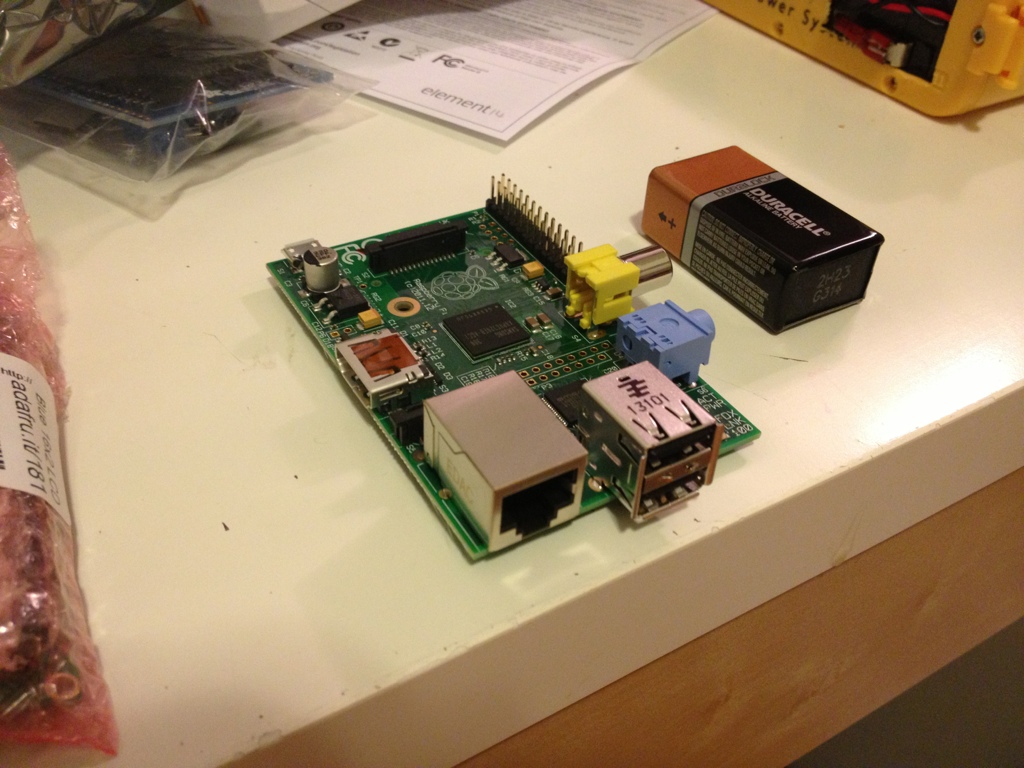
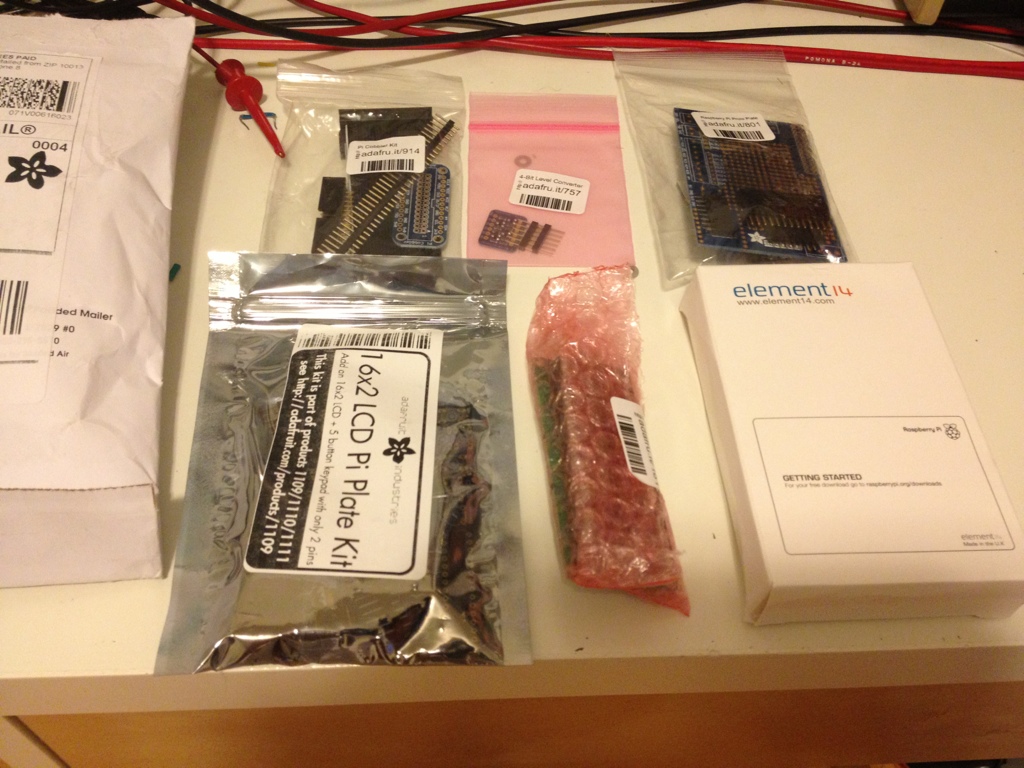
Newly arrived in the mail today! I received my first Raspberry Pi as I feel immediate guilt over the Tindie PIC boards I have waiting to be populated and explored. I look forward to loading up the OS and finding some to plug this into for video… my TV isn’t very practical for hacking away at hardware. I appreciated the low cost of the shipping from Adafruit but the items shipped in a soft pack and the box got somewhat crushed as view below. Maybe it’s a little retentive but I wish they would have shipped it in a small box. Nothing was functionally damaged of course so I can’t complain to much. I’ll spend the evening putting together the LCD interface it, Proto Plate, a little level converter for my BMP085 breakout board (Sparkfun) and The Pi Cobbler kit.


Product links:
Proto Pi: http://adafru.it/801 4 bit level conv: http://adafru.it/757 cobbler kit: http://adafru.it/914 16×2 LCD display: http://adafru.it/181
OP Amps
I remember my first electronics book was a project book with assorted transistor and tube circuits. I steered clear of OP Amps through my younger twenties even.
I recommend some day you’re sitting around at your bench wondering what to make or fix next… day some time to refresh your OP Amp skills.. I could never match W2AEW’s Op Amp video, a great refresher for those who forgot how much we forgot and the newbie!
Talos the Sumo Roomba
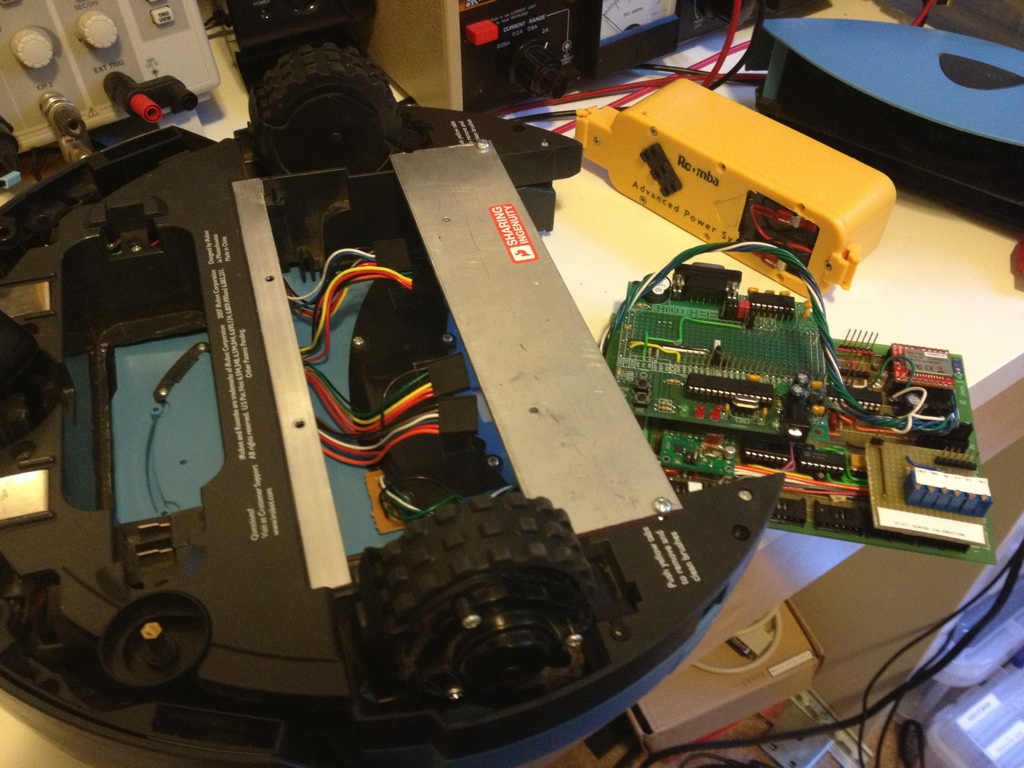
My sumo roomba is running around but has a lot of tweaking yet to be completed.
To do list:
Fix the IR sensor interface, it’s flaky.
Add bumper sensors & code to turn into them.
I probably put too much work into measurements and sensors monitoring. I have a tablet that I can monitor most items in case I want to record anything. It’s bluetooth (the only use for the bluetooth module). You’ll note it runs on two PICs, one for drive and offense/defense, the other for monitoring, communication, and subsystem work. The battery was bad so I dropped a 12V 1.2AH SLA into the case.. not the best fix but it works fine.


Workshop check…
We don’t have “workbenches” any more right? That got boring? Mine is a little pathetic right now. We moved from San Diego out of a tiny 900sq ft apartment with three of us, to this house. So with all this new space I’ve planned on a late May visit to my house in South Dakota which still has my workbench and much of my test equipment. I’ll post a new photo in a few months, you still won’t see much test equipment, I can’t stand being crowded with test equipment; I like plenty of project/arm room. The bench I’m bringing back was a lucky score; I bought it off an electronics factory (that got out-sourced to China)… Not to mention boxes and boxes and boxes of books. I love looking at workshop photos, please comment with yours!

Homebrew TDR
One of my favorite vloggers is w2aew. A recent posting has got me thinking TDR…. supersized. I was planning on playing around with a compass/barometic pressure sensor with the Raspberry Pi but that may wait.. (or perhaps I should pick up a cheapo model A). I don’t use a lot of coax these days but a TDR for CAT5 might be handy. If you watch this video I imagine you can fill in the blanks and see how I believe with an A2D converter and a stable parts (read: frequency) you could have yourself a real nice basic TDR.
5 EA 74AC14 ‘s are $3 and some change right now on eBay. I had some eBay bucks ready to expire so I ended up getting mine for “free”.
I tried the circuit out with a 74LS14 which is obviously turtle powered compared to the ‘AC14.. I could still determine the approximate length of my CAT5 even with the circuit on a breadboard. If you make an attempt the value’s used in the video will not work. If you need a little help ( http://www.electronics-tutorials.ws/waveforms/generators.html ) If you’re going the same route don’t forget CAT5e’s impedance is roughly 100ohms so make the necessary changes in your parallel resistors.